
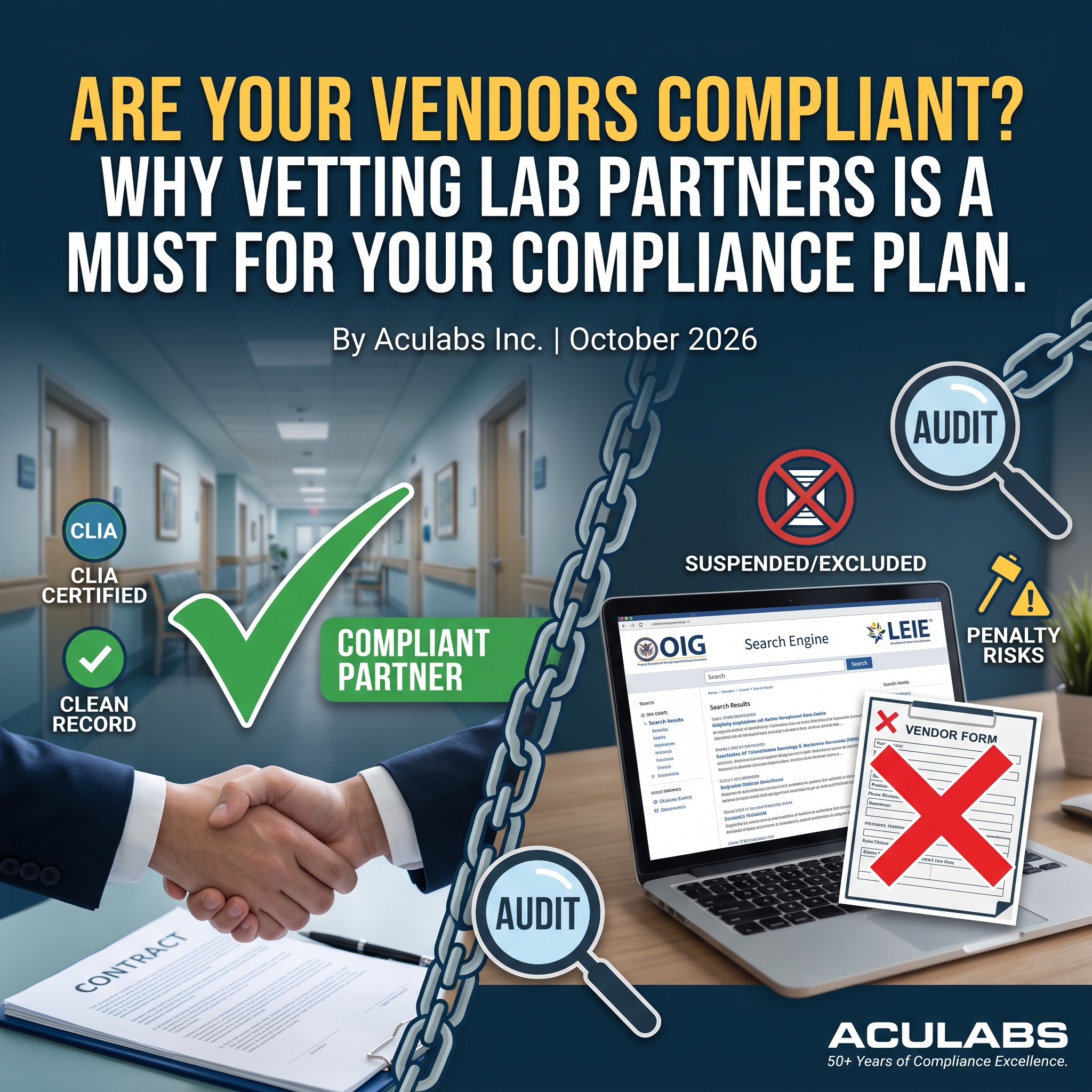
Are You Sure Your Partners Are Compliant? Why Vendor Vetting Belongs in Your Corporate Compliance Plan
By Aculabs Inc. | October 2026
Healthcare facilities operate in one of the most heavily regulated environments in the country. Yet one gap repeatedly surfaces in corporate compliance audits: the failure to systematically vet outside vendors — especially clinical laboratory partners — for their own compliance standing.
It’s a gap that can cost you.
The Quiet Risk No One Talks About
When a long-term care facility selects vendors — whether a laboratory partner, physician group, consultant, or other service provider — the conversation usually CENTERS on service quality, pricing, and operational fit. Compliance due diligence — if it happens at all — may be a quick internet search or a checkbox on a vendor intake form.
What rarely makes it onto the checklist: Are any of these partners — vendors or physicians — currently excluded, suspended, or sanctioned by a federal or state program?
The Office of Inspector General (OIG) maintains a publicly searchable List of Excluded Individuals and Entities (LEIE). The Centers for Medicare & Medicaid Services (CMS) maintains its own suspension and termination records. State Medicaid programs maintain additional lists — New Jersey’s is here. These rosters are updated frequently — and they matter deeply to every facility that bills Medicare or Medicaid.
Why? Because under the Anti-Kickback Statute and False Claims Act exposure principles, knowingly — or unknowingly — doing business with an excluded or suspended entity can trigger compliance violations for your organization, not just theirs.
What a Lab Suspension Actually Signals
A laboratory landing on a Medicaid suspension list is rarely the result of a single paperwork misstep. Suspension actions are typically preceded by:
- Billing irregularities — unbundling, upcoding, or billing for tests not medically necessary
- Audit findings — state or federal program integrity reviews that identify systematic overpayments
- Compliance program failures — absence of credible internal controls, monitoring, or corrective action plans
- Ongoing investigations — fraud allegations under review by law enforcement or program integrity contractors
For a nursing home, assisted living facility, or post-acute care provider, this is material information. If your laboratory partner is under Medicaid suspension, the integrity of every shared transaction deserves scrutiny.
Vendor Vetting as a Compliance Imperative
A robust Corporate Compliance Plan — one that satisfies OIG guidelines and stands up to survey — should include a formal vendor vetting protocol. For laboratory partners specifically, that protocol should address:
1. Initial Credentialing
- Verify CLIA certification and all applicable state laboratory licenses (not just the home state — verify every state in which the lab processes or reports results)
- Confirm CAP or equivalent accreditation status
- Review any publicly available enforcement history with CMS, OIG, or state health departments
2. Ongoing Exclusion Screening
The OIG recommends monthly exclusion screening for all employees — the same standard applies to vendors. Set a calendar reminder. Assign accountability. Document it.
- Screen the OIG LEIE: oig.hhs.gov
- Check state Medicaid exclusion/suspension databases
- Review SAM.gov for federal debarment status
3. Contractual Protections
Your Laboratory Service Agreement should include:
- A representation and warranty that the lab is not currently excluded, suspended, or debarred
- A notification obligation requiring immediate disclosure of any exclusion, suspension, or investigation
- A termination right triggered by any such event
4. Periodic Review
Compliance standing can change at any time. Annual re-credentialing of laboratory vendors — including a fresh exclusion check — should be standard practice.
The Reputational and Financial Stakes
The financial exposure is real. A facility found to have billed Medicare or Medicaid for services rendered by an excluded party may face:
- Repayment demands for all claims associated with the excluded vendor
- Civil Monetary Penalties
- Potential exclusion of the facility itself
Beyond the dollars, consider the survey implications. Deficiencies tied to compliance failures — including inadequate vendor oversight — can affect Star Ratings, trigger focused surveys, and generate unwanted regulatory attention at exactly the wrong moment.
What a Trustworthy Lab Partner Looks Like
A compliant laboratory partner doesn’t just hand you a CLIA number and a courier schedule. They bring:
- A clean and verifiable compliance record — no exclusions, suspensions, or unresolved enforcement actions
- Transparency — willingness to provide licensing documentation, accreditation certificates, and compliance attestations on request
- Contractual accountability — standard agreements that include compliance representations and disclosure obligations
- Institutional depth — compliance programs, billing integrity reviews, and a track record that predates the last sales call
For long-term care facilities navigating an increasingly complex regulatory environment, your laboratory partner’s compliance posture is an extension of your own.
A Final Word
The Medicaid suspension list is not an obscure document. It is a public record — maintained specifically so that healthcare providers can protect themselves and the patients they serve.
If you haven’t recently checked whether your current laboratory vendor is on it, now is a good time.
And if you’re looking for a partner with 50+ years of clean surveys, impeccable licensing records across multiple states, and a compliance culture baked in from day one — we’d welcome the conversation.
Aculabs has served long-term care facilities across New Jersey, Pennsylvania, New York, Delaware, and Connecticut since 1972. We are CAP-accredited, CLIA-certified, and licensed in every state we serve — with an inspection record our clients can verify. Contact us to learn more.
The content in this post is intended for general informational purposes and does not constitute legal advice. Facilities should consult qualified legal counsel regarding their specific compliance obligations.