
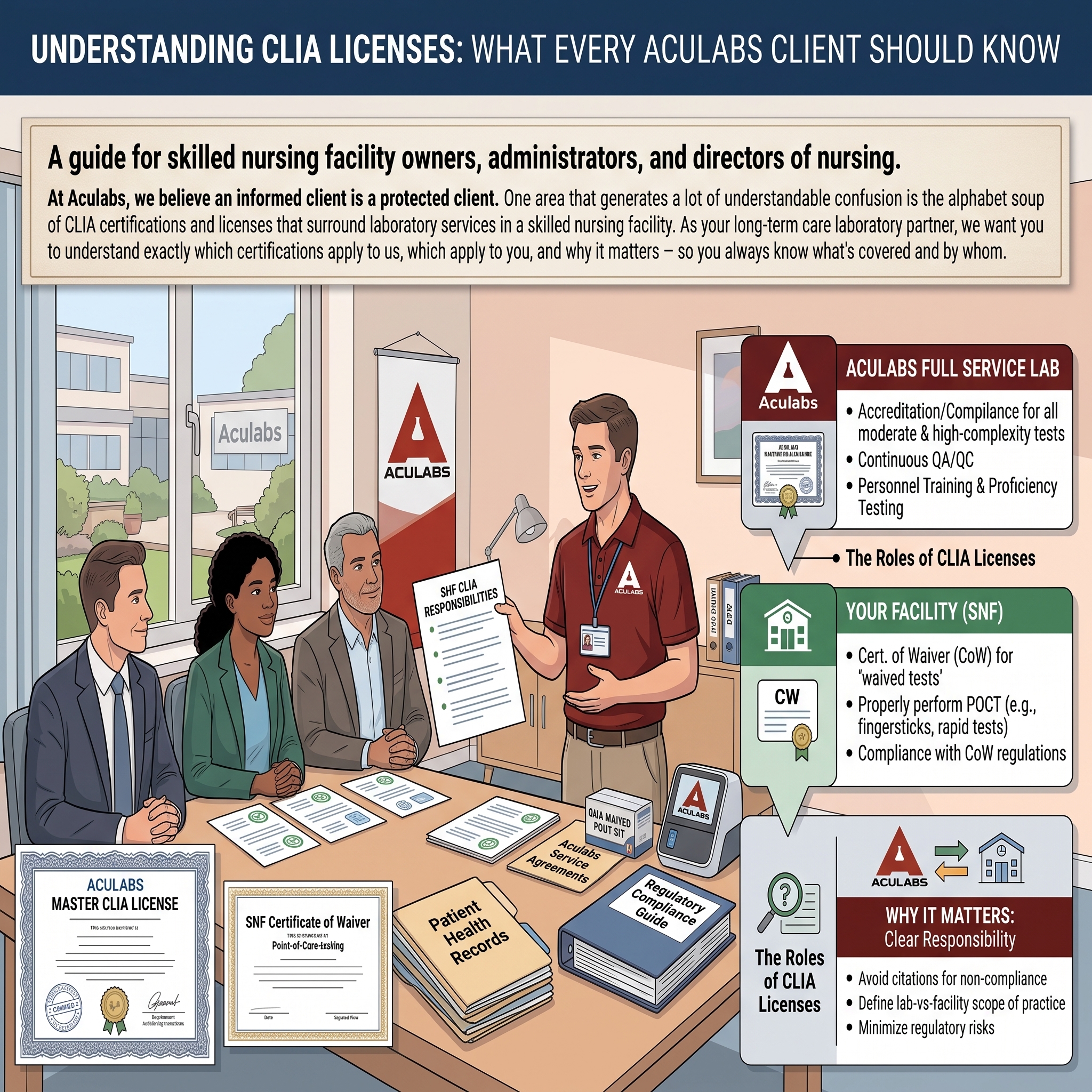
Understanding CLIA Licenses: What Every Aculabs Client Should Know
A guide for skilled nursing facility owners, administrators, and directors of nursing
At Aculabs, we believe an informed client is a protected client. One area that generates a lot of understandable confusion is the alphabet soup of CLIA certifications and licenses that surround laboratory services in a skilled nursing facility. As your long-term care laboratory partner, we want you to understand exactly which certifications apply to us, which apply to you, and why it matters — so you always know what’s covered and by whom.
What CLIA Is, in Plain Terms
The Clinical Laboratory Improvement Amendments (CLIA) is the federal framework, administered by CMS, that regulates virtually all laboratory testing performed on human specimens in the United States. Any entity performing even a single diagnostic test on a specimen needs some form of CLIA authorization. The type required depends on what that entity actually does — and this is where the three categories below come in.
1. Aculabs’ Laboratory Provider CLIA Certificate
Aculabs operates under a CLIA Certificate of Compliance/Accreditation as your CAP-accredited reference laboratory. This is a significantly higher regulatory bar than a facility itself would ever need to meet on its own:
- Our laboratory director meets CLIA’s specific education and experience qualifications.
- We maintain ongoing proficiency testing, documented quality control and quality assurance programs, and personnel competency standards across our testing staff.
- We are subject to biennial on-site inspections by CMS, our accrediting body (CAP), or the state survey agency in each state we operate in.
This is the certificate that authorizes Aculabs to run the moderate- and high-complexity diagnostic testing your residents depend on. It belongs to us — you never need to hold or maintain any part of it — but it’s the credential behind every result we deliver, and we’re always glad to provide documentation of our current certification and accreditation status on request.
2. The “Collection Station” Designation — And Why It’s Ours, Not Yours
In several states, a site where specimens are collected but not tested — like your facility, when our phlebotomists draw specimens for transport to our lab — may fall under a “collection station” designation. Where this applies, it is Aculabs’ licensing obligation, not the facility’s. Your facility never needs to apply for, hold, or renew a collection-station license. (See the state-by-state detail above for how NJ, PA, NY, MD, DE, and CT each handle this.)
3. Your Facility’s Own CLIA Certificate of Waiver
This is the certificate that matters most for your day-to-day operations. If your facility performs any CLIA-waived testing on-site — point-of-care glucose checks, urinalysis dipsticks, rapid strep or flu tests, INR monitoring, rapid antigen tests — your facility must hold its own Certificate of Waiver, issued in your facility’s name, independent of Aculabs’ certification.
Key points:
- It covers only tests CMS classifies as “waived” — simple tests with low risk of error when performed exactly per the manufacturer’s instructions.
- It doesn’t require a CLIA-qualified laboratory director or the quality-system documentation a Certificate of Compliance requires.
- It is conditioned on strict adherence to manufacturer instructions for every waived test performed.
- It’s valid for two years and must be renewed before expiration.
- Your facility — not Aculabs — is legally and financially responsible for this certificate and everything performed under it.
Applying for or Renewing Your Facility’s Certificate of Waiver: Form CMS-116
Whether it’s a first-time application or a renewal, the form is the same: Form CMS-116, CLIA Application for Certification.
Official CMS-116 form (PDF):
https://www.cms.gov/Medicare/CMS-Forms/CMS-Forms/Downloads/CMS116.pdf
A few practical notes:
- Select Certificate of Waiver under Section II, “Type of Certificate Requested.”
- Submit the completed form to your state CLIA agency — not directly to CMS.
- Confirm the current certificate fee with your state agency.
- Begin renewal well ahead of your two-year expiration; a lapse means performing waived testing without valid authorization.
- Report any change in facility name, address, ownership, or laboratory director to your state agency, generally within 30 days.
The Aculabs Commitment
Knowing which certificate covers which activity is the first step toward staying survey-ready. Aculabs carries the weight of laboratory-level CLIA compliance and, where applicable, the collection-station licensing in your state — so your team can focus on what only your facility can hold: your own Certificate of Waiver and the disciplined, manufacturer-compliant testing that keeps your residents safe.
If you have questions about your facility’s current Certificate of Waiver status, an upcoming renewal, or want documentation of Aculabs’ certifications for your own records, your Aculabs account team is always available to help.
State-Specific Collection Station Rules: NJ, PA, NY, MD, DE, CT
The concept of a “collection station” — a site that gathers specimens but doesn’t test them — is handled very differently across Aculabs’ core service states. In every case, it’s important to note: this designation and its licensing burden belong to the laboratory, not the skilled nursing facility. A facility simply allows the lab’s staff to draw specimens on-site; the facility does not need its own collection-station license. Here’s how it breaks down state by state.
New Jersey — NJ has one of the most formalized collection-station frameworks in the region. The state defines a collection station as any facility used for the collection, processing and transmission of specimens to another facility for the performance of clinical tests. Laboratories operating a collection site in NJ — including at a client SNF — must obtain a Clinical Collection Station License from the NJ Department of Health’s Clinical Laboratory Licensing Program, at a fee of $200 for each collection station. A temporary collection-station waiver that had allowed some sites to skip this licensing was revoked effective August 25, 2022, so any lab collecting specimens in New Jersey needs the full license — unlicensed collection has resulted in state enforcement action and fines. www.nj.gov +2
Pennsylvania — PA doesn’t use a separate “collection station” license category for the facility. Instead, the obligation runs through the laboratory’s own permit: no clinical laboratory or other establishment may collect or receive specimens from patients in Pennsylvania for testing unless the laboratory possesses a valid permit issued under state law or holds an appropriate federal license if located out of state. Since 2013’s Act 122, this applies to both in-state and out-of-state clinical laboratories that test specimens collected in Pennsylvania — so an out-of-state reference lab collecting at a PA facility must hold a PA laboratory permit, not a facility-level license. cornellpa
New York — NY explicitly authorizes labs to operate collection sites under their own permit. A clinical laboratory under permit may operate one or more collecting or transfer stations, provided it first obtains written approval from the commissioner for each proposed station, and approval to operate a collecting station must be renewed annually on July 1st in conjunction with the laboratory’s permit. Again, this approval sits with the laboratory (via NY’s eCLEP portal), not the SNF hosting the draw. nyny
Maryland — MD does not publish a distinct “collection station” license category separate from the general clinical laboratory license issued by the Office of Health Care Quality (OHCQ). Specimen collection sites are generally covered under the parent laboratory’s state license and CLIA certificate rather than requiring a standalone facility-level permit — but this is worth confirming directly with OHCQ for any unusual arrangement.
Delaware — DE’s public guidance doesn’t describe a formal “collection station” license distinct from the lab’s own CLIA certification. As with Maryland, any Aculabs collection activity at a DE facility should be confirmed against current Delaware Public Health Laboratory requirements, since state programs do periodically update these rules.
Connecticut — CT actively enforces licensure for stand-alone specimen collection sites. The state’s Department of Public Health has taken enforcement action against unlicensed blood-drawing locations, shutting down eight blood collection centers because they were operating without a license or certificate and ordering the responsible lab to cease operations at those sites until proper licensure was obtained. This makes clear that CT treats collection-site licensure as a real, enforced requirement for the laboratory operating the site. ctwatchdog
Bottom line for facility administrators: whichever state you’re in, the collection-station question is your laboratory partner’s regulatory responsibility, not yours — but it’s a fair and reasonable thing to ask your lab to confirm in writing, especially if you operate across state lines.
Peter Gudaitis
President, Aculabs Inc.