
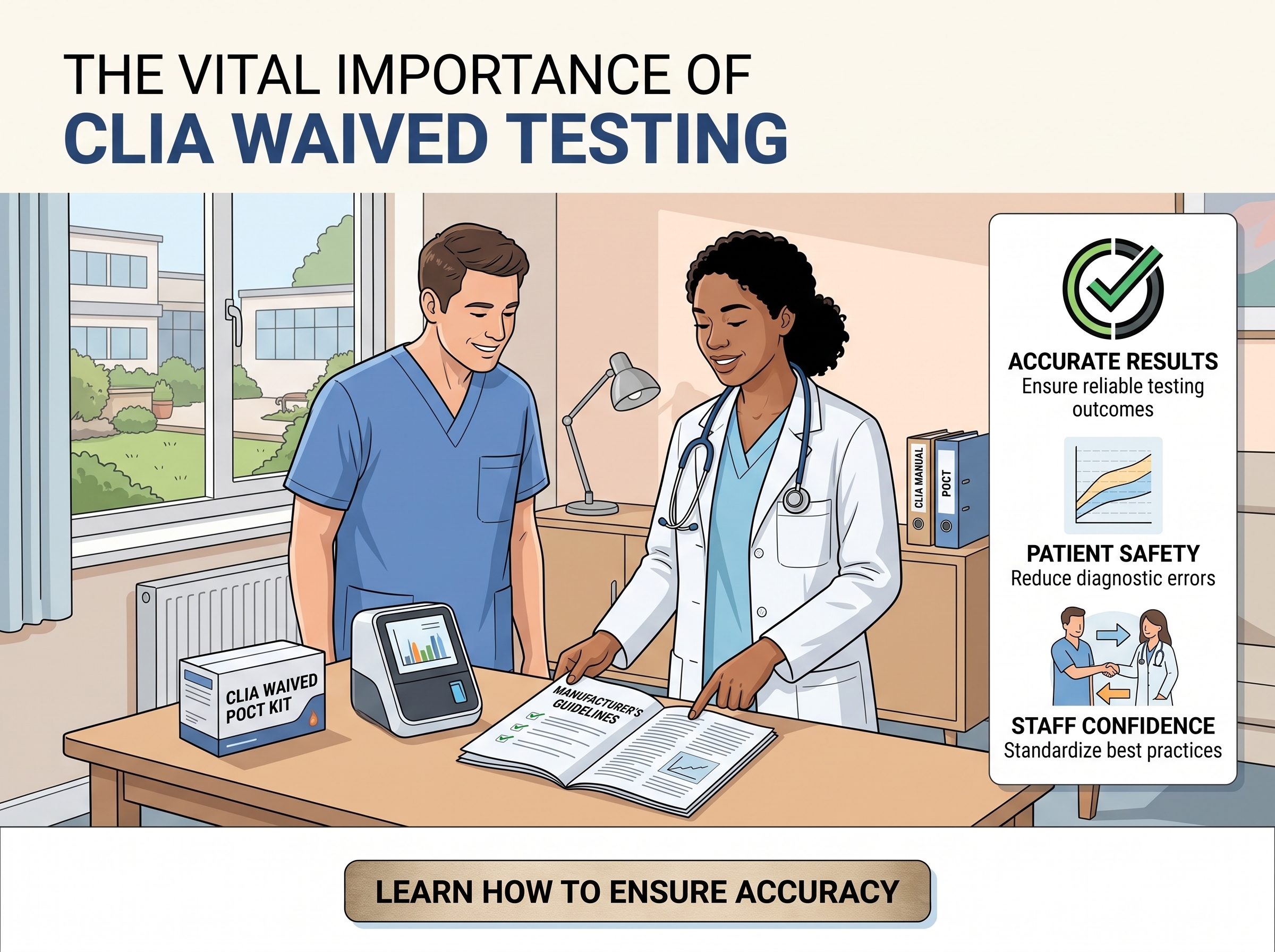
Why Following Manufacturer’s Guidelines Matters for CLIA-Waived Testing in Skilled Nursing Facilities
CLIA-waived tests have become indispensable tools in skilled nursing facilities (SNFs). Point-of-care glucose meters, urinalysis dipsticks, rapid strep and flu tests, INR monitors, and rapid COVID-19 assays allow nursing staff to obtain timely results without sending specimens to an outside laboratory. But the simplicity that earns these tests their “waived” status under the Clinical Laboratory Improvement Amendments (CLIA) can create a false sense of security. A waived test is only as reliable as the process used to perform it — and that process is defined by the manufacturer’s package insert. Deviating from those instructions, even in small ways, can compromise resident safety, invite regulatory scrutiny, and expose a facility to liability.
What “CLIA-Waived” Actually Means
CLIA waiver does not mean the test is exempt from quality standards. It means CMS has determined the test is simple enough, and has a low enough risk of erroneous results, to be performed without the oversight requirements applied to moderate- and high-complexity testing. That determination is based entirely on the test being performed exactly as the manufacturer designed it — using the specified reagents, timing, storage conditions, and specimen types. The moment a facility alters any of these variables, the scientific basis for the waiver no longer applies, even though the facility may still be operating under a CLIA Certificate of Waiver.
Where Deviations Commonly Occur
In the day-to-day pace of an SNF, small shortcuts can creep into testing routines:
- Timing errors — reading a rapid antigen or urinalysis strip too early or too late, which can produce false negatives or false positives.
- Improper storage — leaving test kits or control materials outside their required temperature range, which can degrade reagents without any visible sign of failure.
- Expired materials — using test strips, cartridges, or controls past their expiration date, or after the manufacturer’s open-vial stability window has lapsed.
- Specimen substitution — using a specimen type (e.g., serum instead of whole blood, or vice versa) that the device was not validated for.
- Skipping quality control — bypassing required daily, lot-to-lot, or new-shipment QC checks because staff are confident the device is “probably fine.”
- Untrained or inconsistently trained staff — allowing personnel to perform testing without documented, device-specific competency assessment.
Each of these seems minor in isolation. In aggregate, they represent the most common reasons surveyors cite deficiencies and the most common root causes when point-of-care results don’t match the clinical picture.
The Regulatory Stakes
CLIA regulations (42 CFR Part 493) require that waived testing be performed according to the manufacturer’s instructions as a condition of maintaining the waiver. State health department surveyors and CMS-contracted inspectors can and do review point-of-care testing logs, staff training records, and QC documentation during routine and complaint-driven surveys. Deficiencies related to waived testing can result in:
- Citations under F-tags related to quality of care, if a testing error contributed to a clinical event.
- Referral for state licensing action against the facility’s CLIA certificate.
- In cases involving harm, professional licensure exposure for the staff involved.
For a skilled nursing facility, a CLIA-related deficiency rarely occurs in isolation — it tends to surface during broader survey activity and can compound other findings.
The Clinical Stakes Are Higher Than the Regulatory Ones
Resident safety is the real reason manufacturer instructions exist. A glucose result read a few seconds early can shift an insulin dose. An INR that’s off due to improper specimen handling can lead to a missed bleeding risk or an unnecessary dose adjustment for a resident on warfarin. A rapid flu or COVID test performed on an unvalidated specimen type can produce a false negative that delays isolation precautions and puts other frail, high-risk residents in the building at risk. In the SNF setting — where residents are often older, medically complex, and less able to self-report worsening symptoms — the margin for error introduced by testing shortcuts is thin.
Building a Culture of Compliance
Following manufacturer’s guidelines isn’t a one-time training event; it’s an operational discipline that has to be built into daily workflow.
1. Keep the package insert accessible and current. Every waived test kit should have its current package insert on hand at the point of care — not filed away in a binder in another department. When manufacturers update instructions or QC requirements, that change needs to reach frontline staff immediately.
2. Standardize competency assessment. CLIA requires documented training and competency evaluation for each person performing each waived test, both at hire and periodically thereafter (commonly annually). Competency checks should be device-specific, not generic.
3. Enforce quality control as a non-negotiable step. QC isn’t a bureaucratic add-on — it’s the mechanism that catches a bad lot, a storage failure, or a device malfunction before it affects a resident. Facilities should have a clear, written policy on QC frequency that matches or exceeds manufacturer requirements.
4. Monitor storage and expiration proactively. Simple tools — temperature logs, first-in/first-out inventory rotation, and expiration-date audits — prevent the majority of reagent-related failures.
5. Audit the testing process, not just the paperwork. Periodic direct observation of staff performing waived tests will surface workflow shortcuts that a chart review alone would miss.
6. Treat unexpected results as a signal, not a nuisance. When a point-of-care result doesn’t match the clinical picture, the first question should be whether the test was performed exactly to specification — not simply whether to repeat it.
The Laboratory Partnership Advantage
Facilities that work closely with their laboratory partner on point-of-care testing oversight — competency documentation, QC review, troubleshooting support, and staying current on manufacturer updates — tend to catch these issues before they become survey findings or clinical events. A laboratory partner that treats waived testing oversight as a genuine extension of its quality program, rather than a regulatory afterthought, adds real protective value to the facility’s testing program.
Conclusion
The “waived” in CLIA-waived testing describes the regulatory category, not the standard of care. Manufacturer’s instructions represent the validated conditions under which a test’s accuracy has actually been demonstrated. In a skilled nursing facility, where point-of-care results routinely inform real-time clinical decisions for vulnerable residents, following those instructions precisely isn’t paperwork — it’s patient safety. Facilities that build disciplined, well-documented testing practices around manufacturer guidelines protect their residents, their staff, and their survey standing all at once.
Peter Gudaitis
President, Aculabs Inc.